Carnaval Metamorphoses
1.
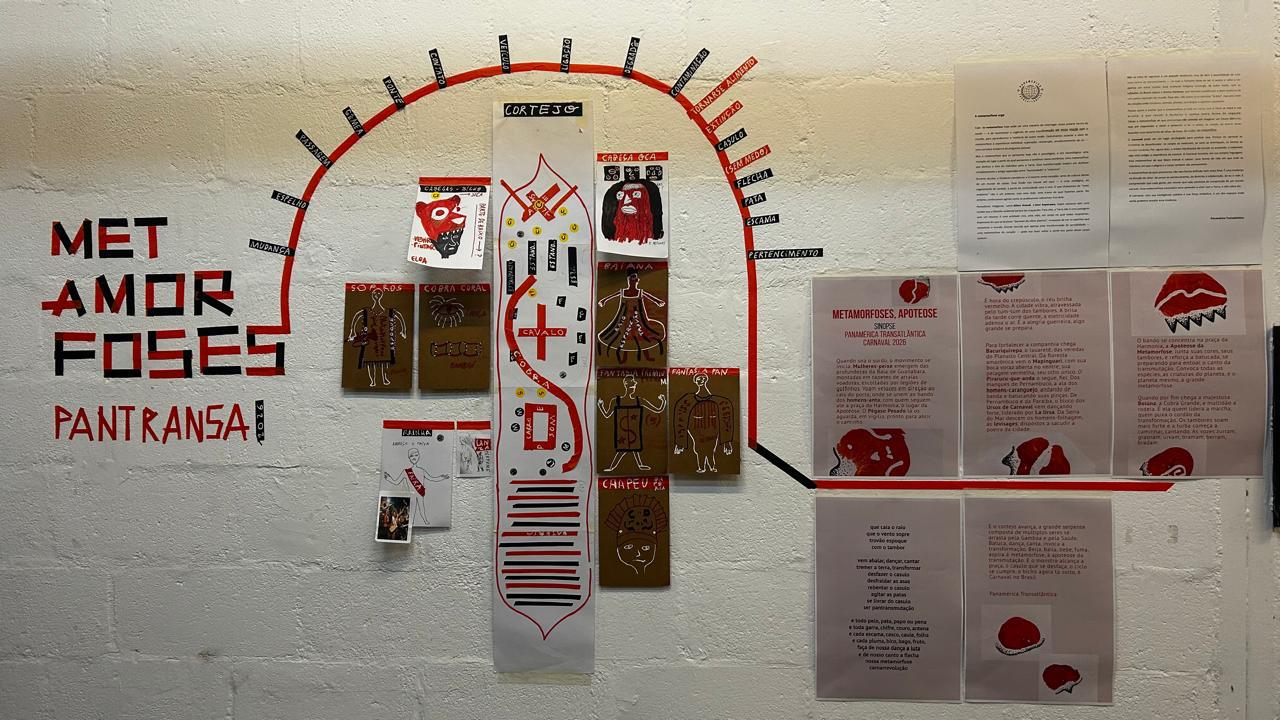
When the bass drum resounds, the movement begins. Fish-women rise from the depths of Guanabara Bay, mounted on carpets of flying stingrays, escorted by legions of dolphins. They speed toward the harbor pier, where they join the band of tapir-men, with whom they proceed to Harmonia Square, the place of Apotheosis. The Heavy Pegasus awaits them there, standing vigil, ready to open the way.
2.
It is twilight, the sky glows red. The city vibrates, pierced by the tum-tum of drums. The evening breeze runs warm, electricity thickens the air. It is warrior joy—something immense is being prepared.
3.
To strengthen the company, my uncle Bacuriquirepa arrives—the Iauaretê—from the backlands of the Central Plateau. From the Amazon forest comes the Mapinguari, with his voracious mouth open in his belly, his red fur, his single eye. The Walking Pirarucu follows him, faithful. From the mangroves of Pernambuco, the wing of crab-men, sidling sideways and drumming with their claws. From Pernambuco and Paraíba, the Carnival Bears dance in with force, led by La Ursa. From the Serra do Mar descend the foliage-men, the levisages, ready to shake the city’s dust loose.
4.
The band gathers in Harmonia Square, the Apotheosis of Metamorphosis. It joins its colors, its drums, and strengthens the beat, preparing to intone the song of transmutation. It summons all species, the creatures of the planet, and the planet itself, to the great metamorphosis.
5.
When at last the majestic Boiúna arrives—the Great Serpent—the crowd surrounds her. She is the one who leads the march, who pulls the cord of transformation. The drums sound louder and the throng begins to move, singing. The voices bray, squawk, howl, bellow, roar, cry out:
6.
let lightning fall
let the wind blow
let thunder crack
with the drum
come to shake, to dance, to sing
to quake the earth, to transform
undo the cocoon
unfurl the wings
burst the cocoon
stir the paws
free oneself from the cocoon
be pan-transmutation
and every fur, paw, crop, or feather
and every claw, horn, hide, antenna
and every scale, shell, stem, leaf
and every plume, beak, berry, fruit,
make of our dance a struggle
and of our song an arrow
our metamorphosis
carna-revolution
7.
And the procession advances, the great serpent composed of multiple beings slithers through Gamboa and Saúde. It drums, dances, sings, invokes transformation. It kisses, sways, drinks, smokes, aspires to metamorphosis, to the apotheosis of transmutation. And the monster reaches the square, let the cocoon be undone, the cycle fulfilled, the creature now runs free—it is Carnival in Brazil.
*
Metamorphosis Urges
To speak of metamorphosis today may be a way of questioning our own manner of existing—and of recognizing the urgency of transforming our relationship with the world, so that we may learn to inhabit it otherwise. We tend to associate the idea of metamorphosis with individual experience: overcoming, reinvention, maturation of the self—a modern narrative of personal progress.
But the metamorphosis that presents itself today is not psychological; it is cosmological: a mutation of the place from which we think and feel our existence. A metamorphosis that shifts the axis from the individual to the Earth. This transformation implies completely undoing the old separation between “humanity” and “nature.”
For centuries, the West regarded itself as an exception: beings of culture before a world of things. This fiction has brought us here—to ecological crisis, to the exhaustion of meaning, to the loss of continuity with the living. What we call the “environment” is not a surrounding backdrop, but a network, a web of which we are part. Yet we continue to act as if we could survive outside it.
Indigenous thinkers such as Ailton Krenak and Davi Kopenawa speak to us with a lucidity Western philosophy seems to have forgotten. For them, the Earth is neither landscape nor resource: it is a living entity, a mother, a body within which we all breathe. Kopenawa says that white people “sleep with their eyes open,” unable to see the spirits that sustain the world. Krenak reminds us that only a transformation of sensibility—a metamorphosis of the heart—can allow us to feel ourselves once more as part of this common body.
This is not about returning to an idealized past, but about opening the possibility of a new form of belonging—one in which the human ceases to be the center and becomes once again only one among many. This Indigenous call converges, in another way, with the reflections of Bruno Latour and Donna Haraway, who also question the modern idea of a subject separated from the world. For them, there is no nature “out there,” but a network of relations in which humans, animals, plants, technologies, and spirits coexist.
To think in this way is to accept that metamorphosis is already underway, that the Earth moves and carries us along, and that resisting change is only another form of denial.
Perhaps the metamorphosis we need does not consist in imagining a different future, but in relearning how to feel the present: the air, the rain, the bodies, the other beings.
To practice a new way of seeing, of touching, of caring, of sharing.
Carnival may be a privileged place to practice this. For in Carnival, boundaries come undone: bodies mingle, sounds intertwine, forms become unstable. For a few days, the hierarchical order of the world is suspended, and something more ancient reappears: the experience of the common. Carnival embodies, in its own language, this metamorphosis of which Krenak and Latour speak: a form of life in which everything relates, in which joy and the body are also thought.
The metamorphosis we need has no defined shape and no final goal. It is a shift in the direction of the gaze: from possession to belonging, from domination to collaboration, from the self to the network. It is to understand that every gesture, however small, participates in the composition of a common world. A necessary metamorphosis would be to learn to live with the Earth, and not upon it.
Carnival, with its collective intelligence and symbolic force, is one of the spaces where we may still rehearse this change.